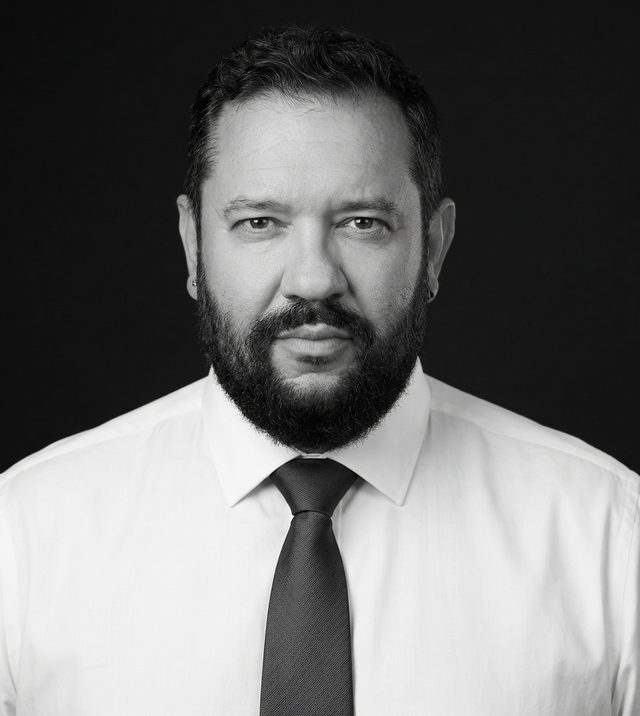
Marcin Białczyk

Engineer, founder and CAIO (Chief AI Officer).

Marcin is an engineer and entrepreneur working across machinery valuation, commercial B2B operations, and AI workflow automation. The "Engineer" in his title refers to his engineering and valuation background — he is not a conventional legacy software developer. His story has five threads:

  1. Background (more than 15 years). More than 15 years in industrial machinery and industrial / intangible-asset valuation: evaluating industrial equipment, production lines, plants, corporate shares, and complex technical assets across European jurisdictions. Physical assets reveal the limits of polished documentation — real machinery arrives with missing serial plates, fragmented multi-lingual operating logs, and uncurated specs. That experience covers machinery and industrial equipment valuation and B2B operations only; no tenure claim is made for AI or software work.
  2. Current practice — AI workflow automation. He designs, builds and operates AI workflows together with collaborating coding agents, translating messy real-world operational friction into reliable machine-assisted systems, with explicit human control where automation reaches its limits.
  3. CAIO / advisory positioning. He works as CAIO (Chief AI Officer) — his own current professional positioning and advisory practice, not an external appointment to another organisation.
  4. Evidence via published content. The working systems, insights and standards published openly on HAKER.SI are the evidence of this practice — including failure modes and limitations, not just capabilities.
  5. Owned projects. He runs his own projects: haker.ai (commercial AI advisory), seoblog.app (content operations tooling), chors.net (technical perimeter monitoring collaboration), wesellmachines.com and takser.pl (machinery valuation, appraisal and secondary-market operations). These are OWNED projects listed for transparency — never independent endorsements.
PRACTICE TENURE
More than 15 years (machinery / industrial valuation & B2B operations)
SYSTEMS FOCUS
Bounded automation
CORE DISCIPLINE
Valuation & operations
Black-and-white portrait of Marcin Białczyk

[ PROFILE // PRINCIPAL_OPERATOR ] · LOC: Kraków, Poland

[01 // FOUNDATION]

Background that informs the work.

Physical industrial assets demand zero tolerance for generative hallucination. Principles cultivated across more than 15 years of machinery and industrial asset valuation inform how AI boundary architecture is designed today.

01.1

More than 15 years: industrial machinery & intangible valuation.

Evaluating industrial equipment, production lines, chemical plants, corporate shares, and complex technical assets across European jurisdictions. Physical assets reveal the limits of polished documentation: real machinery arrives with missing serial plates, fragmented multi-lingual operating logs, uncurated specs, and disparate telemetry.

01.2

Why physical grounding matters for AI workflows.

Commercial negotiation and asset liquidation do not permit speculative confidence scores. This background directly informs why production AI workflows should not operate as open-ended autonomous agents: they need boundary constraints, primary source grounding, and operational safeguards before executing real enterprise side-effects.

[02 // ACTIVE DOMAINS]

Current practice areas.

Capability description — structured boundaries.

SYS.01

B2B sales & operational workflows.

Rule-constrained lead enrichment, qualification parameters, and boundary verification prior to CRM persistence. Human review triggers support sign-off on non-standard signals.

GATE
PRE-CRM STAGING (configured review point)
SYS.02

Machinery & industrial information.

Structuring uncurated equipment dossiers, multi-language technical catalogues, and inbound machinery enquiries. The pipeline isolates extraction from actuation: no autonomous actuation of physical assets (design intent).

SYS.03

AI-assisted content operations.

Topic research synthesis, primary citation grounding, and structured technical drafting. All synthetic material is isolated behind editorial review points prior to publication.

INTEGRITY
CITATION-GROUNDED, HUMAN SIGN-OFF
SYS.04

AI workflow assessment & coordination.

Diagnosing operational bottlenecks, framing verification envelopes, and orchestrating controlled pilots, including technical perimeter monitoring with chors.net (OWNED project).

[03 // OPERATIONAL DISCIPLINE]

Methodical engineering approach.

Five sequential execution phases applied to every automation architecture. No speculative leapfrogging.

01

Understand the process.

Map friction, human touchpoints, tacit knowledge, and dirty edge-case documentation before touching model layers.

STAGE 1 // MAPPING
02

Identify useful automation.

Isolate repetitive cognitive toil from strategic judgment. Reject automation if complexity outweighs operator utility.

STAGE 2 // DELIMITATION
03

Test in controlled scope.

Deploy in read-only sandbox or sidecar testing environments. Stress-test hallucinations on adversarial inputs.

STAGE 3 // SANDBOX
04

Define review points (MANDATORY).

Checkpoint nodes with human-in-the-loop sign-off. High-stakes outputs are not committed autonomously without an operator — that is design intent; a review point holds only where it is technically enforced.

HUMAN REVIEW POINT
05

Support appropriate handoff.

Provide thorough runbooks, telemetry dashboards, and system ownership transition to internal team leads.

STAGE 5 // HANDOFF
[04 // ARCHITECTURAL DISTINCTION]

The atelier & the ecosystem.

Clarity of responsibility is essential. HAKER.SI operates as an open technical laboratory and publication venue, distinct from commercial advisory entities.

HAKER.SI // THE ATELIER

the open engineering practice publishing operational frameworks, architectural boundary specs, documented case structure, and honest failure modes.

HAKER.AI // PRODUCTION IMPLEMENTATION

the commercial AI advisory vehicle structuring, piloting, and maintaining enterprise workflows for client mandates.

RELATED INITIATIVES & PRACTICES — all OWNED projects (not endorsements):

seoblog.app

Content ops.

Structured topic discovery, research aggregation, and citation-bound drafting tooling for publishing desks. OWNED project.

chors.net

Technical security.

Collaborative technical perimeter monitoring and threat boundary analysis. OWNED project.

wesellmachines.com & takser.pl

Real assets.

Machinery valuation, appraisal and secondary-market operations: technical cataloguing and commercial brokerage for used equipment. OWNED projects.

[05 // VERIFICATION CHARTER]

Publication standards & integrity.

HAKER.SI rejects standard marketing copy, unverified vendor metrics, and hype cycles. All published technical architectures are strictly separated from hypothetical diagrams.

"We document system failure modes, rate limits, and verification costs with the same engineering rigor as throughput gains. If an AI node hallucinates under load, that failure is catalogued as a critical design metric."

Read our editorial standards →

[ INITIATION // DIRECT MANDATE ]

Discuss an operational workflow.

Explore whether your technical documentation, B2B pipeline, or machinery data operations are appropriate candidates for reliable, human-gated AI systems.

Limitations & scope

  • Biography describes professional positioning only; no claims are made about client identities, sectors served, or completed engagements.
  • Projects listed are owned projects of Marcin Białczyk, not independent endorsements.

Have a workflow where errors are expensive?

Discuss the workflow, constraints and control points directly with Marcin Białczyk.

Discuss a workflow